
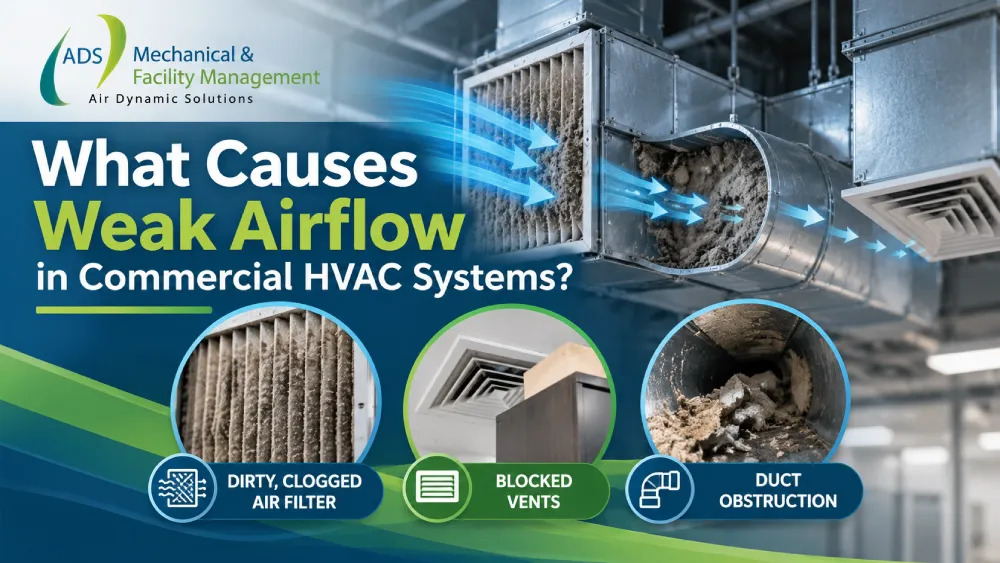
Weak airflow commercial HVAC systems directly threatens daily business operations by failing to distribute conditioned air evenly. With low airflow commercial HVAC, the building cannot reach the thermostat setting fast enough, forcing large fans and rooftop compressors to run continuously. This heavy overwork spikes building electricity bills while starving vital cooling parts of the return air they need to function safely. Without proper air circulation, indoor temperatures plummet and freeze the coils solid.
This pushes liquid refrigerant backward and can cause complete compressor burnout. Beyond expensive physical damage, stagnant air raises indoor carbon dioxide levels. It creates air quality issues that violate local commercial building codes and risk heavy regulatory fines. To protect your facility from these structural breakdowns, you must understand how air volume interacts with internal system friction. This guide helps you recognize the key symptoms and major causes of commercial HVAC airflow problems early.
Signs of Poor Commercial HVAC Airflow
Temperature and Comfort Imbalances
Weak air distribution strips away the velocity needed for conditioned air to reach a facility’s outer walls. This uneven push creates extreme indoor micro-climates, leaving interior meeting rooms freezing cold while perimeter offices turn into hot boxes. Stalled air movement slows the natural air-renewal process, allowing carbon dioxide to build up and leaving your office occupants feeling sluggish and unfocused. Without a strong mechanical pull to drag old air back through the return grilles, everyday body heat, chemical compounds, and breakroom odors become physically trapped inside the workspace.
Building Pressure Problems
Poor HVAC airflow ruins the balancing act required to keep your building pressure stable. Commercial air balancing systems are engineered to maintain a slightly higher internal pressure than the outdoors, but when supply fans weaken while exhaust systems keep running, the entire building turns into a structural vacuum. This negative vacuum physically pulls on exterior doors, making them heavy to push open or causing them to slam shut violently on their own. This pressure imbalance forces high-velocity outside air to rush through tiny window cracks, producing a loud whistling noise while introducing humid outdoor air straight into your walls.
Equipment Overwork and High Costs
Low air velocity forces massive central fans to run significantly longer to satisfy the temperature demands of localized thermostats. Because the air isn’t moving fast enough to change the room temperature, the system draws heavy electricity hour after hour without ever cooling the building. This lack of warm return air causes the surface temperature of your indoor cooling coils to drop below freezing, turning natural air moisture into solid sheets of ice. This growing ice barrier restricts the remaining air paths completely, triggering safety switches that force the rooftop compressors to shut down and restart rapidly until the machinery burns out.
Main Causes of Weak Commercial Airflow
Filter Mismatches and High Static Pressure
Upgrading building filters to high-efficiency models to meet green guidelines often creates an unexpected block for your airflow. These advanced materials act like a solid wall that heavily increases resistance, suffocating the fan if the motor speed isn’t adjusted to compensate. This issue worsens when maintenance crews neglect the complex, multi-stage filtration setups found inside commercial air handlers. Changing the cheap outer pre-filters while leaving secondary pocket or bag filters in place for years blinds the system with deep-set dust, dropping the total air volume.
VAV Box and Damper Failures
Commercial spaces rely on specialized air-mixing boxes hidden above ceiling tiles to regulate airflow into individual office zones. Over time, the internal gear trains or pneumatic parts inside these boxes wear down, causing the actuators to jam and freeze the dampers in a closed position. This mechanical failure completely blocks air entry into that specific office area. Furthermore, if the small pressure sensors inside these mixing boxes get dirty or drift, they send lower-than-actual data to the central computer, mistakenly commanding the dampers to lock shut tightly.
Mechanical Issues in the Air Handler
Traditional systems connect the fan motor to the blower wheel using a rubber belt that naturally stretches and slips over time. This structural slack means that even if the motor runs at full capacity, the fan spins well below its required rate, dropping supply duct velocity. Aerodynamic failure also occurs when micro-fine dust bypasses bad filters and coats the curved blades. Even a thin layer of grime completely destroys the smooth shape of the blade, causing it to slice uselessly through the air instead of pushing it forward.
Ductwork and Layout Disruptions
Remodeling floor plans or adding partition walls during tenant fit-outs can trap and block the main distribution trunks originally designed for wide, open layouts. Beyond physical layout barriers, the internal fiberglass insulation linings glued inside commercial sheet metal can degrade and separate after decades of service. High internal air pressure then peels these fiberglass sheets away from the metal walls, causing them to collapse inward and form a physical flap that bottlenecks the moving air.
Deep Coil Fouling and Freezing
Commercial cooling coils are deep and tightly packed, featuring multiple rows of metal fins that easily trap fine dust when low-quality filters fail. This micro-dirt gets packed deep into the center layers where standard surface washing cannot reach, forming a permanent physical wall that chokes moving air. This chronic restriction starves the loop of heat, dropping coil temperatures until condensation freezes into a solid block of ice that completely seals off the duct network.
How to Troubleshoot Weak Airflow
Audit the Digital Controls
Isolating an airflow drop starts by checking your central building dashboard for active static pressure alerts. If sensors detect a severe resistance spike anywhere in the network, the digital controls will purposefully slow down system speeds to prevent ductwork damage. You must check the operational log of your variable speed drives to ensure the fan motors are ramping up to full frequency instead of getting stuck in an energy-saving mode. Finally, monitor thermostat connections, as an offline zone sensor will force the system to close localized air dampers as a basic safety precaution.
Inspect the Physical Hardware
Safely cut central power to inspect the air handler’s rubber fan belt for cracks and mechanical slack, ensuring it does not slip on the pulleys and prevent the blower wheel from hitting its design speed. Use a bright light to check the curved pockets of your fan blades and the deep faces of multi-row cooling coils for a gray fuzzy layer of accumulated dust. If the central unit is clean, check the localized mixing boxes above problem rooms to ensure external metal linkages rotate smoothly when temperature settings change.
Measure System Pressure Drops
Insert diagnostic pressure probes into pre-drilled holes directly before and after your filter banks and cooling coils to measure live pressure differences. Comparing these manometer readings against manufacturer limits instantly proves if dense filter fibers or dirty coil rows are acting as a physical choke point. If pressure logs are clean but certain rooms remain dead zones, bring in an air balancing professional to measure vent outputs and reset manual internal volume dampers.
Final Analysis
To prevent weak airflow commercial HVAC, your facility must shift from a reactive mindset to a structured preventive maintenance schedule. Waiting for tenants to complain about stale air forces you to pay emergency repair premiums, rush shipping fees, and peak labor rates when components suddenly break down. A proactive plan tracks real-time pressure drops using gauges. It ensures inexpensive pre-filters are replaced before they can blind your secondary high-efficiency filters. Routine quarterly checkups let teams tension fan belts and perform deep chemical coil flushes before peak seasonal weather arrives. If you are looking for a reliable partner to handle your entire facility’s HVAC needs, contact the Air Dynamic Solutions team right away.
FAQs
Can dirty filters reduce commercial HVAC airflow?
Yes, as filters collect dust and debris, their internal openings clog and create a massive surge in resistance across the filter bank. This high static pressure drop chokes off the fan’s ability to push air, slashing your total air volume delivered to the workspaces.
Can duct problems cause low airflow?
Yes, ducts that are too small or feature sharp bends create permanent structural restrictions that severely bottle up moving air. Also, unsealed seams or internal insulation blankets that peel away and collapse can let conditioned air escape or physically block the air path entirely.
What is the difference between an airflow problem and an equipment problem?
An airflow problem means the machine’s mechanical core works perfectly, but restrictions like clogged filters or jammed dampers prevent the system from distributing air through the building. An equipment problem means an actual moving part, like a fan motor or compressor valve, has suffered a physical breakdown.
Can air balancing improve uneven HVAC airflow?
Yes, air balancing is the professional method used to measure live air volume coming out of every ceiling vent using diagnostic hoods. Technicians adjust internal volume dampers to restrict oversupplied rooms, safely forcing excess air to travel down the duct network to reach starved, uncomfortable zones.