
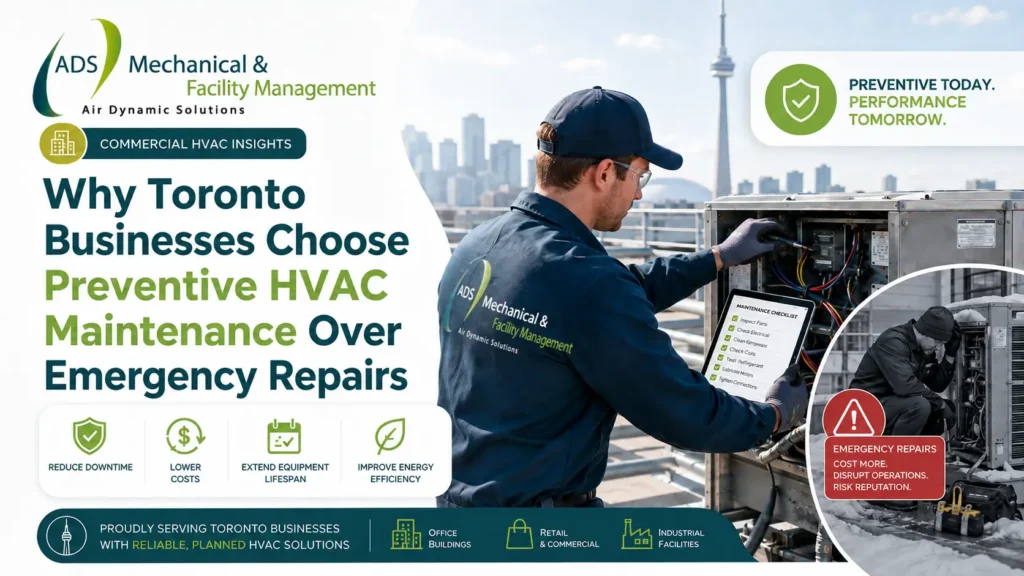
Commercial Buildings In Toronto experience unique environmental and mechanical pressures due to extreme seasonal changes, from sub-zero freezing winters to highly humid summers. It puts massive strain on heavy systems, pushing them to their physical breaking points. When a heatwave or deep freeze hits Toronto, hundreds of systems fail simultaneously. This creates a rapid demand for a local Toronto HVAC contractor. Ignoring preventive HVAC maintenance Toronto pushes you to wait hours or even days for a technician, paying premium emergency dispatch fees. You may also experience extended delivery delays for replacement parts stuck in high-demand supply chains.
Property managers often assume they are saving money by avoiding monthly Commercial HVAC Maintenance Toronto fees. But in reality, they mistake a “running system” for a “healthy system”. A neglected system operates with clogged filters, unlubricated bearings, and slight refrigerant leaks. The system draws up to 30% more energy monthly just to combat its own restricted airflow. When it eventually fails, the breakdown is usually catastrophic. That’s why choosing preventive maintenance is not optional; it’s mandatory for Toronto businesses. These services are usually performed during the “buffer seasons” when technicians are widely available, and rates are standard.
Financial Comparison: Emergency Repairs vs Preventive Maintenance
Emergency Costs
When a commercial HVAC system suffers an unmanaged breakdown in the Greater Toronto Area (GTA), the financial consequences escalate immediately due to high localized demand and emergency fee structures. Standard commercial service calls during normal hours in Toronto average around $250+ HST. However, a peak-season emergency can spike up to $600+ HST just to get a technician to the site.
Maintenance Costs
A proactive maintenance program eliminates financial unpredictability. It moves the business from an emergency operational expense (OPEX) model to a controlled budget. In such programs, rather than facing unpredictable repair bills that can range from around $3,000 per minor incident or up to $45,000 for major component failures, businesses pay a fixed, stable annual contract rate. Labour costs also remain comparatively lower than peak-season services.
The Financial Return
Reactive “run-to-failure” maintenance costs 25% to 30% more overall than structured preventive care. This means every emergency repair costs an average of 4.8 times more than performing the exact same fix as a scheduled maintenance task. In preventing minor maintenance issues, low-cost adjustments catch small anomalies before they cause widespread system damage. These programs also help in reducing overall building operational energy consumption by up to 18%.
The Impact of Toronto’s Climate on HVAC Systems
Winter Demands
Toronto’s winters place a severe mechanical load on commercial heating systems. It forces equipment to run almost continuously for months. Temperatures regularly drop below -10°C, with extreme cold snaps dipping to -25°C or lower with wind chill. This pushes commercial boilers and rooftop gas-fired furnaces to run at 100% capacity for days at a time just to maintain legal indoor building temperatures.
Summer Demands
In Toronto, summer comes with high humidity. It places a massive latent heat load on commercial cooling equipment. Peak months frequently see temperatures cross 30°C, with humidex values routinely climbing above 35°C. That’s why a Commercial Air Conditioner has to lower air temperature and pull moisture out of the air. This overload triggers component failures demanding immediate commercial HVAC repair Toronto.
Seasonal Scheduling
Smart building managers avoid the rush by timing their inspections during Toronto’s mild transition months. The fall window is the ideal time to prep heating systems for the winter surge. Technicians check everything thoroughly to ensure all hydronic line insulation is intact to prevent frozen pipes. The spring window is used to transition buildings from heating to cooling while technicians work to prevent indoor water damage and replace belts.
Energy Efficiency and Utility Bill Savings
How Neglect Forces Excess Electricity Draw
Restricted Airflow
Airborne dust, construction debris, and seasonal pollen clog commercial air filters. This increases system static pressure. To push air through this restriction, variable frequency drive (VFD) blowers and supply fans must spin faster and longer. Restricted airflow from dirty filters can reduce system conveyance energy efficiency by up to 60%. You can bring it back to normal through expert Commercial Heating and cooling Toronto services.
Insulated Heat Transfer
Evaporator and condenser coils rely on clean metal-to-air contact to absorb heat. Similarly, the dust layer accumulation acts as an unwanted thermal insulator. This forced insulation prevents efficient heat transfer. It also raises internal refrigerant temperatures and head pressures. Fouled or dirty condenser coils increase overall HVAC energy consumption by up to 40%.
Mechanical Drag
Loose or worn fan belts slip on their pulleys, wasting mechanical energy through heat rather than moving air. Concurrently, unlubricated motor bearings create rotational drag. This forces motors to pull more amperage to achieve the required rotational force, driving up baseline energy consumption.
How Regular Cleaning and Calibration Solve The Issue
Aerodynamic & Thermodynamic Flow
Professional coil washing by HVAC maintenance services Toronto clears compressed grime and scale, restoring original heat-rejection capabilities. Combined with timely filter changes, this drops system operating pressures back to baseline specifications. The system cools and heats the space much faster, dropping the length of run cycles and cutting electricity use.
Ontario’s Commercial Rate Hikes Impact
Managing energy efficiency is highly critical for local businesses due to recent Ontario Energy Board (OEB) Rate Updates. Even after accounting for provincial rebates, net commercial electricity costs have risen by over 15%. Peak daytime business hours cost a premium of 20.3¢ per kWh. Keeping systems optimized prevents overworked HVAC systems from drawing excess power during these high-cost hours.
Managing Peak Demand Charges
For larger commercial properties, Toronto Hydro bills are heavily driven by the single highest 15-minute spike in power usage during the month. An unmaintained HVAC system that struggles to start or short-cycles spikes local power draw. Regular electrical calibration and component lubrication flatten these consumption spikes. It drops thousands of dollars off peak demand charges.
Preventive Maintenance Saves Businesses More Than Emergency Repairs
| Aspect | Key Risks | Financial Impact | Preventive Measures |
| Customer Impact | Uncomfortable climate leads to short visits and bad reviews. | Lost sales and costly reputation repair. | Regular HVAC servicing. |
| Productivity | Extreme temperatures result in low focus and high errors. | 6–10% productivity loss. | Maintain 21–22°C; routine checks. |
| Tenants | HVAC failures cause lease breaches and disputes. | Tenant churn $20k–$100k+. | Reliable HVAC upkeep. |
| Capital | Neglect leads to early depreciation. | Replacement $15k–$500k+. | Preventive programs extend lifespan. |
| Wear & Tear | Minor friction develops into major failures. | $20 neglect becomes $3,500 repair. | Lubrication, cleaning, alignment. |
| Warranty | Lack of service logs voids warranty. | Owner pays full replacement. | Documented seasonal maintenance. |
Practical HVAC Tips and Suggestions for Business Owners
In-House Visual Checks
Monthly visual audits of thermostats and vents prevent minor issues from escalating into expensive equipment failures. Program thermostats to realistic occupied schedules and use lockable covers to stop staff from triggering system short-cycling. Also, verify that all supply vents stay completely unobstructed by warehouse stock. Blocked vents disrupt the building’s balanced static pressure. They put a dangerous mechanical strain on your fan motors.
Filter Replacement Schedules
Air filters are your primary defense line to protect complex internal components from circulating dust and debris. Standard buildings should replace pleated filters every three months through professional Preventive Maintenance For Commercial HVAC to maintain unrestricted airflow. High-traffic properties or areas near construction require an accelerated replacement interval. No matter the calendar schedule, if a monthly check reveals a dirty filter, replace it immediately.
Clear Outdoor Units
Rooftop systems and ground condensers need an entirely unobstructed envelope of ambient air. Throughout spring and summer, clear out trapped cottonwood seeds, leaves, and weeds to maintain a two-foot safety perimeter. Toronto’s winter brings severe drifting snow and ice accumulation that can quickly bury low-profile fresh air intake pipes. Keep these pathways entirely clear to prevent pressure-fault safety lockouts from shutting down your heating system instantly.
System Documentation
Meticulous record-keeping treats your HVAC infrastructure like a corporate asset, directly protecting your property’s long-term bottom line. Maintain a centralized service log tracking all technician invoices, component changes, and fluid updates categorized by serial number. These records allow facility managers to spot expensive, chronic problem units and choose replacement over endless temporary fixes. A verified, multi-year maintenance history also adds explicit capital value to your property during future appraisals.
Final Analysis
Keeping an eye on all emerging issues and early symptoms and getting preventive HVAC maintenance Toronto in a timely manner saves you time and money. It also helps keep your HVAC system’s peak-season performance high. However, the most important factor is not only getting services at the right time, but also from a specialized service provider. In the Greater Toronto Area and Ontario, Air Dynamic Solutions is the leading HVAC maintenance service provider. Their extensive experience and high commercial and industrial expertise make them an ideal choice for emergency HVAC repairs Toronto.
FAQs
How often should Toronto businesses schedule HVAC maintenance?
They should do it at least twice a year. High-traffic environments or properties near heavy urban construction often require quarterly inspections. This is because they have to manage intense air filtration and structural debris.
How can preventive HVAC maintenance reduce repair costs?
Technicians use specialized diagnostic tools to spot and replace cheap micro-components. This early intervention prevents cascading physical stress from destroying expensive major parts.
How can Toronto businesses prevent unexpected HVAC breakdowns?
They can do so by pairing seasonal professional inspections with monthly internal checks. The regular monthly tests include thermostats, air vents, and outdoor clearance zones by commercial HVAC services Toronto.
Is preventive HVAC maintenance worth the investment for Toronto businesses?
Yes. Industry stats show a consistent 4-to-1 financial return on investment. This means every dollar spent on proactive maintenance saves four dollars in emergency costs. The predictable monthly budgeting completely eliminates the extreme financial threat of sudden building closures.