
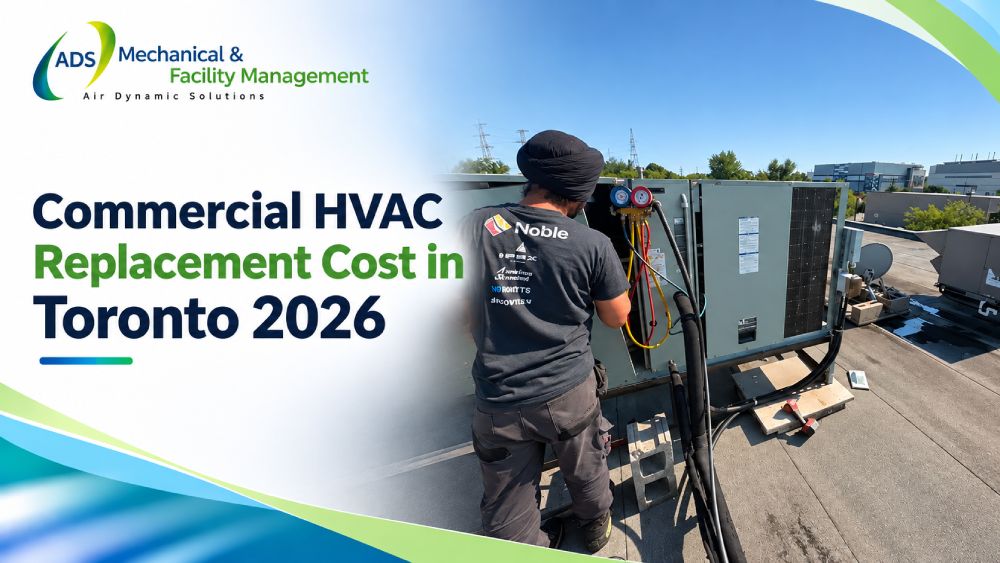
The creation of a reliable asset management plan for Toronto commercial properties heading into the late 2020s is a frustrating process. Property managers regularly forecast long-term capital allocations without baseline data because mechanical equipment pricing is kept strictly under wraps. Attempts to balance operational budgets based on pure guesswork leave stakeholders vulnerable to massive budget overruns when central systems hit end-of-life cycles. This severe lack of localized data is challenging in Ontario, where capital planning faces intense strain from scheduled carbon tax hikes.
Unlike typical residential systems, Commercial HVAC infrastructure pricing depends entirely on custom engineering reviews, private supplier relationships, and highly variable labor calculations. Every institutional property comes with unique architectural challenges, which means a system replacement cannot be priced out as a simple commodity purchase. Procuring major equipment is tied to confidential manufacturer frameworks, while the actual installation requires a breakdown covering permits, crane rigging, and building automation controls. As a result, generic online price estimators fail completely to reflect the actual capital investment needed for a code-compliant system overhaul.
Commercial Rooftop Unit Replacement Costs
The Budgetary Range
A closer look at typical light to mid-sized commercial Rooftop Units (RTUs) shows that localized expenses vary depending on tonnage configurations and occupancy rules. For light commercial spaces like small retail storefronts or local strip malls, replacing a system of smaller tonnage requires a modest capital allocation.
Mid-sized commercial offices upgrading to moderate tonnage capacities generally fall into a significantly higher price bracket, whereas larger facilities needing substantial tonnage units plan for a heavy layout. For high-capacity institutional systems requiring massive capacity, capital pricing starts at a major premium and easily climbs past six figures per unit.
Key Cost Drivers
The base procurement cost of a commercial RTU is heavily dictated by necessary roof support reinforcements, curb adaptations, and low-ambient control packages. If the physical dimensions of the new equipment don’t match up perfectly with the existing roof footprint, a custom steel curb adapter has to be fabricated.
Furthermore, compliance with regional energy requirements forces the integration of advanced modulating dampers, enthalpy sensors, and specialized low-ambient head pressure control kits. These mechanical additions ensure that the cooling functions can run safely even during freezing outdoor temperatures.
Logistical Variables
Execution of a successful RTU replacement in dense urban zones means budgeting for city road closure permits, crane mobilization, and electrical upgrades. Standard boom crane rentals for properties up to a few storeys run a several-thousand-dollar daily fee based on local rates.
High-reach, all-terrain hydraulic cranes for setups exceeding half a dozen storeys will run you a massive premium on a daily baseline. On top of that, getting municipal street occupation permits requires booking weeks in advance, paired with mandatory paid duty police officers for active lane closures.
Commercial Boiler Replacement Costs
The Budgetary Range
A review of modern high-efficiency condensing and near-condensing multi-stage commercial boilers reveals a massive gap in capital requirements across different facilities. Small commercial installations using hydronic heating setups of lower thermal output usually wrap up at a baseline commercial rate within the region.
Mid-capacity hydronic boilers of moderate output for corporate offices or mid-rise multi-residential properties demand a substantial asset allocation from the ownership group. Heavy high-capacity industrial boilers or multi-boiler cascading setups scale rapidly into peak spending brackets, requiring intense long-term financial planning.
Key Cost Drivers
The main equipment cost variance comes down to a structural choice between traditional cast-iron sectional units and stainless-steel high-efficiency heat exchangers. Atmospheric cast-iron units offer a lower upfront price tag but severely limit thermal efficiency, locking the property into higher utility spending.
A choice for premium stainless-steel condensing boilers increases your upfront manufacturer acquisition costs but drastically lowers long-term Enbridge Gas operating expenses. Their ability to modulate pushes thermal efficiency close to absolute peak performance, which qualifies the facility for substantial carbon tax offsets.
Logistical Variables
Mechanical budgets for boiler retrofits must factor in complex boiler room chimney re-lining, gas line pressure adjustments, and complete hydronic loop flushes. Because high-efficiency condensing systems generate highly acidic condensate, traditional B-vent or masonry chimneys cannot be reused during the process.
The system must be completely lined with Polypropylene or AL29-4C stainless steel venting to withstand the regular exhaust output. Furthermore, any setup exceeding baseline commercial thermal limits mandates a formal TSSA design registration fee along with mandatory field inspector site visits and sign-offs.
Commercial Chiller Overhaul and Replacement Costs
The Budgetary Range
Budgetary guidelines for large-scale institutional air-cooled and water-cooled chillers cover a broad capital spectrum across the greater metropolitan area. Packaged scroll-compressor air-cooled chillers built for small to mid-sized facilities of modest capacity require a substantial capital expenditure from ownership.
Upgrading to medium-capacity air-cooled screw chillers requires an investment range that effectively doubles that baseline for the equipment procurement. Massive water-cooled centrifugal chiller central plants command premier capital allocations, with highly complex projects that replace cooling towers and condenser pumps easily scaling past the million-dollar mark.
Key Cost Drivers
The overall equipment cost of a central chiller is dictated by your selection of compressor types, staging systems, and integrated variable frequency drives. Choice of magnetic-bearing oil-free centrifugal compressor technologies adds a significant premium to your procurement baseline during the design phase.
However, a combination of these oil-free configurations with integrated variable frequency drives allows the chiller to match part-load building cooling demand perfectly. This layout completely eliminates expensive oil-management maintenance routines and drops part-load energy use to flatten peak electrical spikes.
Logistical Variables
Logistical spending for chiller overhauls includes rigging expenses through tight urban utility access points, environmental noise compliance, and proper cooling tower integration. Downtown properties with restrictive basement doors or tight rooftop mechanical access often require a complete knock-down shipment configuration from the supplier.
The chiller is delivered completely in pieces and assembled directly inside the room, adding a ton of specialized mechanical labor costs. Additionally, compliance with strict decibel thresholds requires outdoor air-cooled configurations to feature acoustical sound blankets or structural noise barriers.
Variable Refrigerant Flow System Replacement Costs
The Budgetary Range
A layout-driven framework dictates how you size up multi-zone Variable Refrigerant Flow (VRF) heat recovery systems across conditioned spaces. For smaller layout footprints under a few thousand square feet, such as medical clinics, a complete installation averages a standard five-figure amount.
Medium-sized multi-tenant office layouts spanning moderate square footage range significantly higher all-in due to the increased indoor fan counts. Large-scale decentralized retrofit overhauls for expansive complexes over tens of thousands of square feet start deep into six figures because of the high volume of components.
Key Cost Drivers
The capital equipment cost of a VRF deployment is determined entirely by the layout density of connected indoor coils and branching selectors. Selection of a three-pipe heat recovery system over a standard two-pipe heat pump configuration adds a heavy equipment premium to the budget.
This advanced hardware setup allows for simultaneous heating and cooling across different building zones, such as cooling a server room while heating an office. Total system pricing scales linearly based on zone density, as the addition of individual wall cassettes drives up raw component counts.
Logistical Variables
Onsite logistical variables for VRF installations involve high-precision copper refrigerant line running, extensive controls commissioning, and finished multi-room ceiling retrofits. VRF technology requires thousands of linear feet of copper linesets routed through existing building envelopes, demanding precision brazing under continuous nitrogen purge.
Contractors must execute a mandatory high-pressure decay test up to peak safety limits to verify line integrity before operation. Because retrofitting these lines through finished drywall or occupied drop-ceiling voids is incredibly labor-intensive, routing labor comprises a significant portion of final billing.
Critical Capital Cost Factors for Toronto Facilities
Seasonal Labor Trends
A proactive strategy to schedule a major commercial mechanical change-out during the regional shoulder seasons minimizes building operational downtime. Delays that lead to a reactive emergency failure during peak summer cooling or winter heating crunches force operations into premium emergency labor tiers.
Licensed refrigeration mechanics or steamfitters charge much higher overtime rates when responding to sudden system failures during extreme seasonal weather. Proactive capital change-outs scheduled during spring or autumn shoulder months cut net installation labor rates and eliminate temporary spot-cooling or heating rental requirements.
Rebate Optimization
Strategic adoption of active Ontario Enbridge Gas and municipal decarbonization incentives provides an effective path to safely lower upfront capital investments. Under the provincial utility framework, facilities upgrading to high-efficiency condensing boilers can secure direct incentives from conservation programs.
These options are supplemented by custom commercial energy-retrofitting programs providing financial kickbacks for verified building portfolio efficiency performance. Additionally, a transition from legacy fossil-fuel appliances to variable-speed, cold-climate VRF heat pumps unlocks municipal green infrastructure grants that offset equipment procurement.
Engineering Compliance
A clear grasp of how structural load assessments, provincial building regulations, and municipal mechanical permits shift project pricing is vital. Any major mechanical structural modification requires strict adherence to Ontario Building Code SB-10 compliance criteria, forcing formal energy modeling validation.
Furthermore, because modern high-efficiency chillers or RTUs differ in weight from obsolete legacy models, a professional engineer must perform a roof-load evaluation. This layout assessment can demand structural steel support reinforcement if deemed physically necessary by the engineering firm.
Final Analysis
Reliance on generalized square-foot calculators or unverified templates introduces severe capital risk, frequently leaving property managers exposed to unexpected rigging premiums and municipal permit delays. For an accurate capital asset plan that eliminates forecasting uncertainty, facility teams should partner with a verified engineering specialist. Property stakeholders can connect with the certified team at Air Dynamic Solutions to eliminate all budgeting uncertainty by obtaining a comprehensive, free on-site evaluation and itemised quote session tailored precisely to their building’s infrastructure needs.