
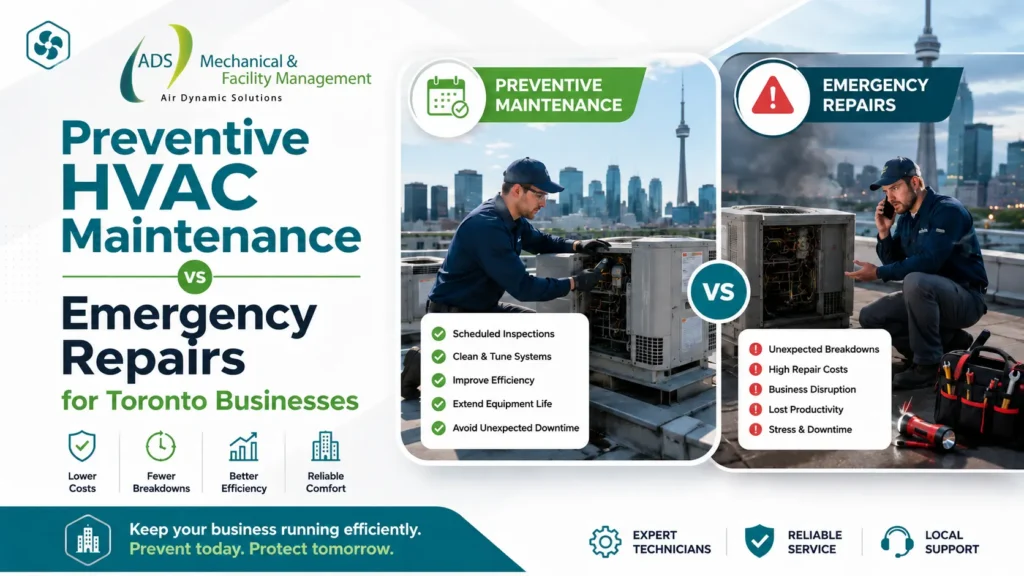
A commercial building preventive maintenance checklist is not a superficial expense, but it serves as a core risk-mitigation strategy that safeguards a landlord’s or business’s largest physical asset. You face a severe financial impact if you neglect it. This occurs because unmaintained commercial structures lose asset value at three times the rate of buildings with structured Commercial Facility Maintenance programs. For every dollar you spend on proactive, routine maintenance, you save an average of $4 in catastrophic emergency repair costs or early capital equipment replacement. This saving is highly relevant because Toronto’s geographic location creates a demanding environment for commercial building materials and mechanical infrastructure.
The city experiences severe seasonal temperature swings, since conditions drop to -15°C or lower in peak winter and rise to 31°C+ with heavy humidity in summer. This constant cycling causes rapid thermal expansion and contraction across building materials. Similarly, structural damage from water seepage and mechanical fatigue is common in Toronto. These issues occur due to extreme weather conditions, which do not allow the building’s mechanical core to rest properly. Therefore, a structured preventive commercial building maintenance schedule acts as an operational shield. It protects property managers from unexpected budget spikes and legal trouble.
HVAC & Climate Control
Spring/Fall Changeovers
Commercial HVAC maintenance checklist in Toronto require central plant transitions twice a year. Fall boiler servicing occurs between September and October, whereas spring chiller maintenance takes place between April and May. Technicians should clean fire tubes and inspect burner assemblies because even a thin soot layer drops boiler heat transfer efficiency by 12%. Spring upkeep requires anti-freeze loop draining and biocide tower scrubbing. Furthermore, missing ASHRAE 188 chemical logs risk immediate, Legionella-related building closures.
Air Quality Maintenance
You risk mechanical failure and damage to tenant health if you neglect air distribution networks, because this issue forces ventilation infrastructure to work harder. Technicians should replace filters every 90 days in standard environments. If you upgrade from cheap fiberglass filters to pleated MERV-11 or MERV-13 models, you can trap up to 90% of airborne particles. Consequently, this practice protects sensitive internal coils and electronics.
System Controls
Centralized Building Automation Systems misregulate microclimates when internal thermistors naturally drift by 1°C to 3°C over time. If a sensor drifts high in winter, it forces boilers to run unnecessarily. This outcome makes bi-annual sensor calibration critical for efficiency. Additionally, facilities should audit automated preventive maintenance schedule to ensure comfort levels do not run during weekends or overnights.
Building Envelope & Roofing
Bi-Annual Roof Inspections
Commercial flat roofs in the GTA face extreme thermal movement. Therefore, property teams should thoroughly inspect them every Spring and Fall. Continuous temperature cycling causes roofing membranes to tear. These tears allow water to saturate underlying insulation long before a ceiling drip appears. Meanwhile, stagnant “ponding” water standing for over 48 hours exerts heavy hydrostatic pressure, and it adds dangerous dead weight.
Drainage Systems
Late autumn leaves, twigs, and organic sediment frequently clog roof drains and gutters. They cause rain or winter slush to back up under flashings, so water leaks into interiors. Escaping building heat melts the bottom layer of roof snow. This water runs down to cold roof edges and freezes into ice dams. Ultimately, this ice block traps subsequent runoff, backs water directly under roofing layers, and creates dangerous icicles.
Sealants & Masonry
Damaged sealants and masonry cracks compromise the building envelope’s thermal barrier. As a result, they ruin overall energy efficiency. Exterior window and door caulking degrades from UV exposure and high winds. These lines require annual inspections to prevent winter drafts, so rain cannot rot interior framing. Similarly, porous bricks and concrete blocks are highly vulnerable to Toronto’s freeze-thaw cycles.
Plumbing & Winterization
Pipe Insulation
Exposed plumbing lines in unheated zones will freeze rapidly when Toronto temperatures plunge. Because water expands 9% when freezing, it creates up to 25,000 psi of hydrostatic pressure. This immense force splits copper or steel pipe walls. Since this damage causes severe flooding during thaws, facilities should wrap exposed pipes with 1.5 to 2 inches of closed-cell elastomeric foam insulation sleeves for protection down to -20°C.
Sump Pumps & Water Heaters
Proactive testing ensures core operational systems can successfully handle sudden volumetric loads from heavy spring rainstorms or rapid winter snowmelts. Sump pump Commercial Property Maintenance requires that you manually test the automatic float switch, and it involves clearing pit debris. Technicians should also verify the check valve and test backup battery power. This complete check prevents low-level foundation flooding.
Toronto Backflow Prevention Bylaw
Under Toronto Municipal Code Chapter 851, all ICI and multi-residential buildings require strict premise isolation to protect the public water supply. Facilities should install approved backflow preventers immediately following the property’s main water meter. A licensed Specialist has to physically test these devices at installation, annually, and within 72 hours of any repair.
Electrical & Fire Safety
Ontario Fire Code Compliance
Commercial property operators must maintain on-site compliance logbooks for at least 7 years. Monthly tasks require that you test a manual pull station and verify monitoring signals. Technicians should also clean backup battery terminals, and they need to test emergency light battery packs for 30 seconds. Annually, certified specialists are required to individually activate all smoke detectors, heat sensors, and strobes while performing a full 90-minute backup battery diagnostic discharge.
Infrared Thermography
Loose electrical connections, corroded breakers, and uneven phases create invisible resistance. This resistance translates into dangerous, localized heat buildup. Infrared thermography utilizes thermal cameras to scan live, fully energized distribution panels. It also checks main switchgear, transformers, and bus ducts under normal operating loads. Pinpointing these abnormal temperature spikes allows technicians to fix hotspots before they trigger arc flashes or explosive failures.
Sprinkler Systems
These systems require regular pressure and valve checks to serve as an effective, instantaneous defense against thermal damage. Control valves require visual verification monthly. This routine includes wet-pipe pressure gauge checks that help detect internal supply line leaks, faulty backflow preventers, or major corrosion. In unheated areas, dry-pipe systems deploy compressed air or nitrogen, so technicians can ensure that freezing water cannot shatter the lines.
Exterior & Grounds Maintenance
Winter Preparedness
Under the City of Toronto Municipal Code Chapter 719, commercial property owners are legally required to clear ice and snow from adjacent public sidewalks within 12 hours after a snowfall ends. You face direct municipal fines if you fail to clear these paths.
Similarly, the Occupiers’ Liability Act places a strict duty of care on property managers, so you have to ensure all visitors are safe. Slip-and-fall lawsuits on icy commercial walkways are incredibly expensive. Therefore, proactive salting and ploughing schedules serve as a business’s primary shield against multi-million-dollar personal injury claims.
Parking Lot & Lighting
During late winter and early spring, melted snow trickles into tiny structural fractures in the asphalt parking lot. Overnight, that water freezes and expands, so it fractures the surrounding sub-base. As heavy delivery trucks drive over these hollowed pockets, the asphalt collapses and forms a deep pothole.
You should also inspect parking surfaces every spring. Deep potholes require immediate hot-mix asphalt filler, but you can use a temporary cold-patch during winter. This rapid action prevents vehicle damage, and it eliminates pedestrian tripping hazards while it stops water from completely undermining the underlying foundation layers.
Final Analysis
Preventive maintenance for commercial buildings is a strategic safeguard. It not only prevents your building from mechanical degradation but also enhances the performance and productivity of staff by boosting indoor air quality. In Toronto, following a building maintenance checklist is not optional. You have to comply with the rules strictly. For this purpose, you need only a reliable local maintenance contractor who understands the regulatory measures and possible issues inside out. If you are looking for someone who handles your entire building on your behalf, letting you focus only on your business growth, contact Air Dynamic Solutions right away. They are the leading HVAC contractors for specialised service in the Greater Toronto Area and Ontario.
FAQs
What is a commercial building maintenance checklist?
It is an operational risk-mitigation document used by property managers. This checklist tracks, verifies, and documents routine inspections and safety tasks across a property’s structural and mechanical assets.
How often should commercial buildings be maintained?
Maintenance operates on a continuous, multi-tiered cadence depending on the asset. This includes weekly control valve checks and monthly safety testing. It also spans biannual seasonal changeovers and comprehensive annual system certifications.
What does preventive maintenance include?
It includes structural weather protection, HVAC seasonal transitions, and air quality optimization. It also encompasses plumbing freeze protection, electrical hazard detection via thermal imaging, and municipal code life-safety compliance testing.
What systems need regular maintenance in commercial buildings?
The core systems are central HVAC plants, building automated controls, and air distribution ductwork. You must also protect the exterior building envelope, plumbing winterization networks, and active fire protection infrastructure.
How do you create a preventive maintenance schedule?
You map out the building’s physical inventory and establish a chronological tracking log. This relies heavily on seasonal climate demands, manufacturer guidelines, and local statutory mandates like the Ontario Fire Code or Toronto Water Bylaws.