
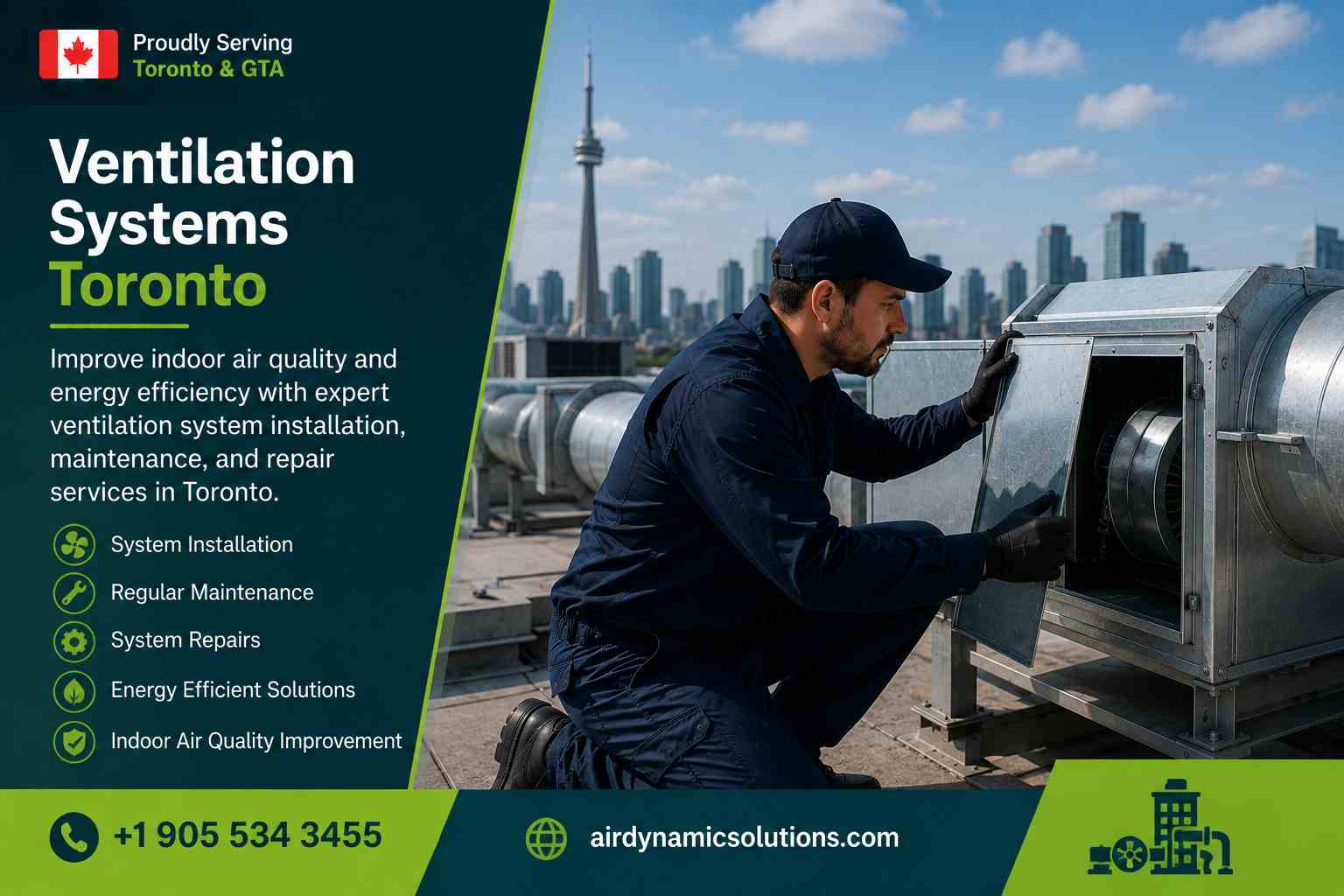
Air Dynamic Solutions offers HVAC ventilation systems Toronto services across the GTA and Ontario, including design consultation, professional installation, preventive maintenance, and performance optimization. Our technicians assess facility air quality requirements, evaluate existing ventilation infrastructure, recommend system configurations, and implement solutions that support healthier indoor environments. With more than two decades of HVAC experience, we work across a wide range of ventilation system types and configurations.
We provide air ventilation systems Toronto services that support indoor air quality through adequate fresh air supply, effective contamination removal, and balanced air circulation throughout facilities. We review existing ventilation adequacy to identify capacity limitations, check ductwork integrity to confirm air delivery, consider filtration effectiveness, and adjust system operation for improvement. We work with commercial buildings, healthcare facilities, educational institutions, and industrial buildings, aiming to sustain healthy indoor air conditions. Our expertise covers both new installations and upgrades to existing facilities seeking improved air circulation, contamination control, or efficiency optimization.





We review facility characteristics, including occupancy levels, space functions, equipment generating heat or contaminants, and building envelope tightness to help determine ventilation requirements. Our commercial air ventilation Toronto team checks outside air intake quantity against regulatory standards and occupant comfort objectives, and measures air movement patterns to support adequate ventilation.
We develop ductwork systems intended to deliver air supply to facility areas while helping minimize pressure losses that increase fan energy consumption. Our duct sizing considers air volume and velocity requirements to help reduce excessive noise or insufficient circulation, while supply and return duct layout is planned to limit obstructions and lengthy runs that may lower distribution efficiency.
Our industrial air ventilation Toronto experts suggest filtration approaches aligned with your facility’s air quality objectives and occupancy requirements. Our particulate filters help reduce dust, pollen, and fine particulate levels, while activated carbon filters are used to manage odors and volatile organic compounds. HEPA filtration is applied to support contamination control in sensitive environments.
We carry out system testing after installation, measuring air flows, temperature patterns, and contaminant levels to check whether design specifications are being met. Our ventilation system installation Toronto team reviews carbon dioxide concentrations to indicate outside air introduction. They also assess air movement patterns to help support consistent circulation throughout spaces.
We design ventilation systems for diverse facilities, aiming to improve comfort, energy efficiency, and installation feasibility through practical engineering.
We service and maintain ventilation systems across varied brands and configurations, supporting facilities with different equipment needs.
We coordinate ventilation with heating, cooling, and facility management, helping systems work together to support overall building performance.
We meet current building codes and ventilation standards, staying updated on evolving regulations to help maintain compliance.

Occupants experiencing stuffiness, odor accumulation, or fatigue may indicate inadequate ventilation, and carbon dioxide concentrations above 800 ppm can point to limited outside air introduction. We carry out assessments measuring air quality indicators and compare findings with regulatory ventilation standards.
Facility staff are encouraged to monitor outdoor air intakes, keeping areas clear of leaves, trash, and obstructions to help support outside air access. Return air vents should ideally remain unobstructed by furniture or stored materials. In many cases, visual filter inspection helps facility teams recognize when professional replacement may be needed, while reporting unusual noises, reduced air movement, or odor concerns can support timely professional response.
Many existing systems can often accommodate filter upgrades or enhanced filtration without extensive modifications. We review existing infrastructure to identify upgrade opportunities and assess implementation feasibility. Some situations may require expanded ductwork or equipment modifications for substantial capacity increases. We discuss upgrade options, implementation approaches, and timeline expectations to support informed decisions.
Increased ventilation generally leads to additional fan energy consumption but may also ease other equipment demands through improved humidity or temperature control. System optimization through proper balancing and controls can help reduce unnecessary fan operation, while variable speed fans may lower energy use during periods of reduced occupancy. We discuss operational implications during system evaluation, helping provide realistic assessments of performance and cost trade‑offs.
Reach out to our certified team for air quality assessment, ventilation system design, installation services, or maintenance program development.
This website uses cookies to enhance navigation, analyze site usage, and provide relevant content and advertisements. By using this website, you agree to our use of cookies as described in our Privacy Policy. You may accept, reject, or manage optional cookies at any time.