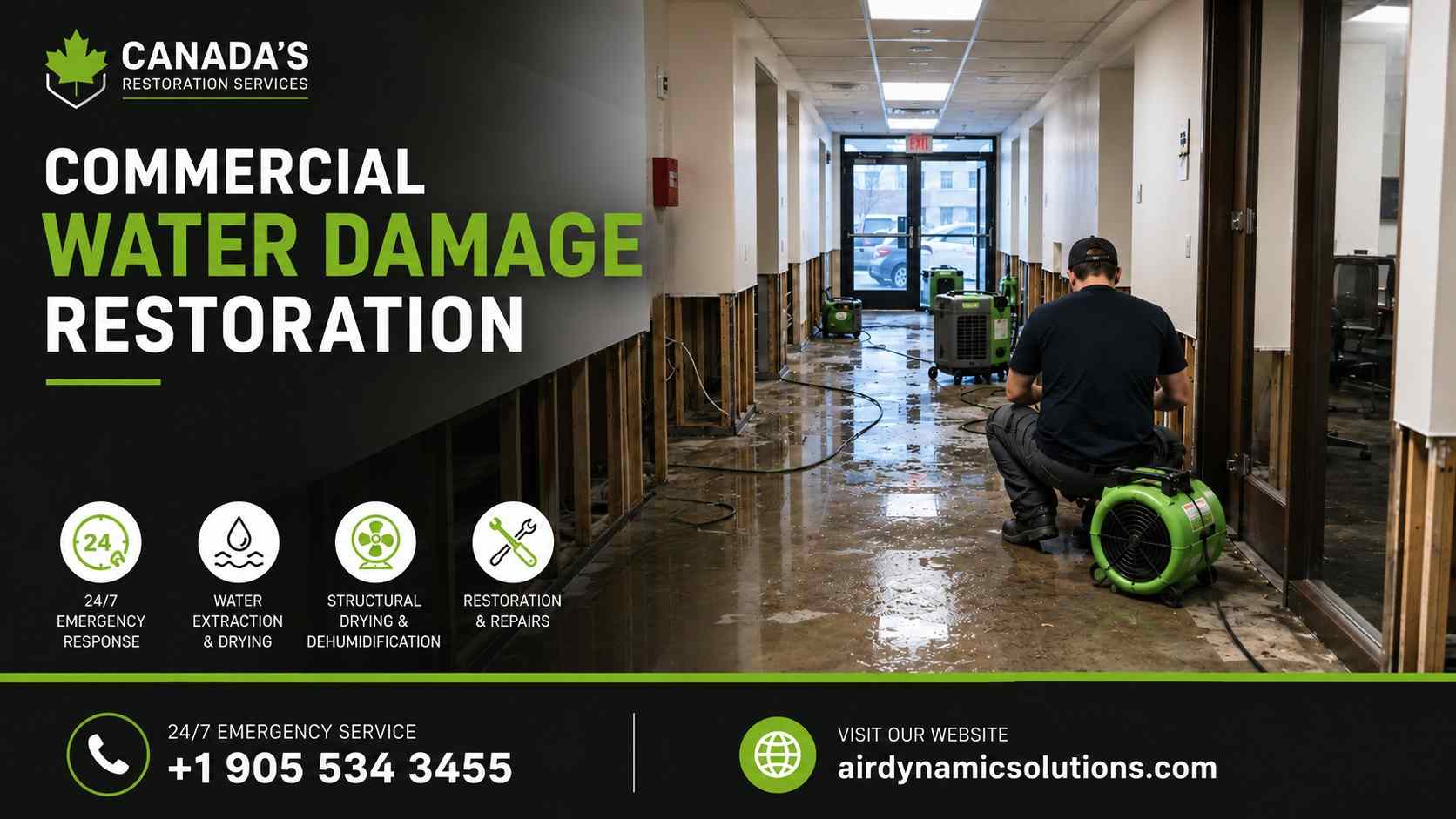
Air Dynamic Solutions provides commercial water damage restoration in Toronto, helping coordinate the response to water intrusion events across the GTA and Ontario’s commercial and institutional building sector. Our certified teams assess affected systems and assemblies on arrival, execute a sequenced remediation and restoration program guided by moisture data, and work to help restore facilities to their pre-loss condition in line with insurer documentation standards.
Our Toronto water damage restoration services are engaged following pipe bursts, plumbing failures, sprinkler activations, roof drainage failures, appliance malfunctions, sewer backups, and building envelope leaks that introduce water into commercial buildings across the GTA and Ontario. We serve office buildings, hotel properties, restaurants, healthcare facilities, educational institutions, retail operations, and multi-location corporate portfolios. Our team draws on over 20 years of commercial facility experience, with in‑house mechanical capability, WSIB compliance, Ontario Ministry of Labour safety adherence, and full liability insurance supporting each restoration engagement.


Our water damage restoration in Toronto technicians work to trace the water intrusion source in line with OBC requirements, whether a burst pipe, failed drain, roof blockage, membrane issue, or mechanical fault, and then aim to isolate or repair it before extraction and drying begin. This sequence is intended to help prevent remediation efforts from being undermined by ongoing water introduction into the building fabric.
Our services for emergency water damage Toronto use truck-mounted and portable extraction equipment scaled to the volume of water present, working systematically across affected floor areas, wall cavities where water has migrated behind finishes, and below-grade spaces where drainage is limited. Extraction is sequenced to move water toward removal points while helping avoid contamination spread across unaffected areas of the building.
We apply commercial-grade desiccant and refrigerant dehumidifiers, high-velocity air movers, and, where necessary, injectidry or equivalent CSA-approved systems that introduce dry air directly into wall cavities and floor assemblies without requiring demolition to access them. Drying equipment placement and settings are adjusted daily based on moisture readings across affected assemblies.
Our Toronto water damage restoration technicians review the contamination category of the water involved, such as clean, grey, or black water, and apply the appropriate extraction, disinfection, and material disposal protocols. Contaminated materials that may not be safely remediated in place are removed and disposed of in compliance with Ontario environmental and Ministry of Labour regulations.
We work to confirm and isolate the water source before remediation, addressing plumbing or mechanical failures in‑house to help prevent repeated damage.
All extraction, drying, and reinstatement steps are guided by measured moisture data, with daily monitoring to support verified dry baselines.
Our licensed mechanical and electrical teams assess, dry, and carry out repair work on affected systems to support faster recovery.
We coordinate each phase, from emergency, extraction, drying, verification, and reinstatement, helping maintain smooth compliance.

Mould growth in commercial building materials may begin within 24 to 48 hours of moisture exposure under typical indoor temperature and humidity conditions, provided the affected materials have sufficient organic content to support growth. The risk is not uniform across all materials; mould tends to establish preferentially in drywall paper, ceiling tile, carpet backing, and wood framing before developing on concrete or masonry surfaces.
Water damage restoration typically addresses intrusion events originating within the building. Flood damage, in insurance and restoration terminology, generally refers to water entering a building from an external ground-level or below-grade source. The remediation process for both commonly involves extraction, drying, and reinstatement, but flood events more frequently involve contaminated water, below-grade structural exposure, and foundation drainage considerations.
This depends on the material type, the saturation level, the duration of exposure, and whether contamination is present. Non-paper-faced gypsum board, certain insulation types, and porous ceiling materials frequently cannot be dried to OBC‑accepted moisture levels without removal, regardless of drying equipment deployment.
Our insurance documentation includes damage photos, baseline and interval moisture readings, prepared to insurer and OBC documentation standards, written scope of affected materials, drying equipment records, contamination assessment, disposal logs, reinstatement scope, and post‑restoration confirmation.
Reach out to us immediately to initiate an emergency response and discuss a developing water intrusion situation with our team available 24/7.
This website uses cookies to enhance navigation, analyze site usage, and provide relevant content and advertisements. By using this website, you agree to our use of cookies as described in our Privacy Policy. You may accept, reject, or manage optional cookies at any time.