
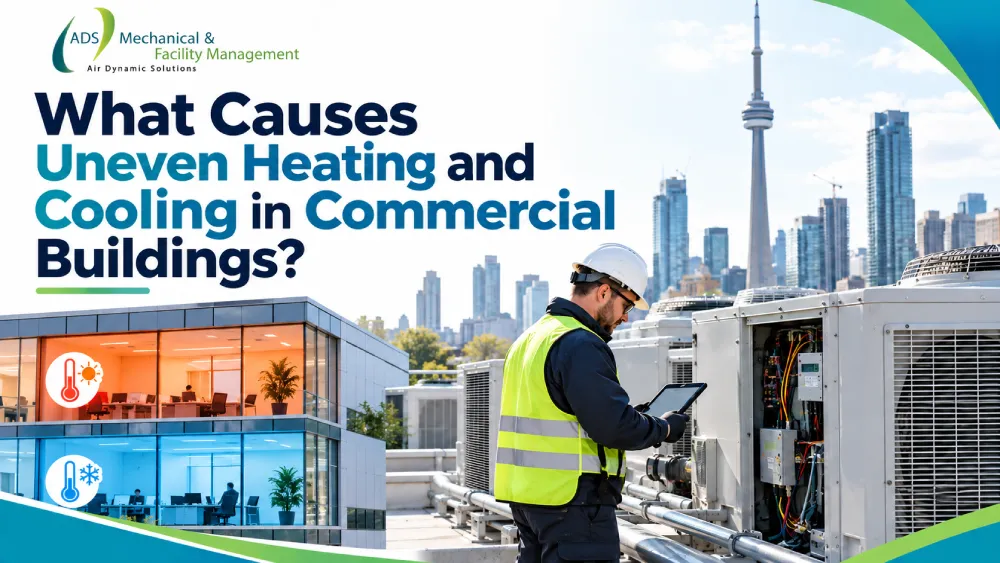
Modern open-plan offices and highly insulated building envelopes frequently suffer from micro-thermal imbalances that standard centralized systems cannot handle. While a perimeter office facing intense afternoon sun experiences rapid solar heat gain, an interior server room insulated from the building’s exterior envelope remains locked in a permanent cooling loop. Thermal stratification further aggravates this uneven heating and cooling commercial building. This creates extreme horizontal and vertical micro-climate gradients that completely decouple thermostat readings from actual human-level conditions.
These micro-thermal deviations directly erode a property’s financial performance by raising operating costs and reducing labor output. When temperature deviations force occupants out of their physiological thermal neutral zones, cognitive errors spike and labor productivity drops by measurable percentages. To compensate for localized hot or cold spots, primitive building automation systems over-cycle VAV boxes and boilers, causing short-cycling. This over-compensation places severe mechanical strain on RTUs, leading to premature system failures and significant spikes in utility consumption.
Building Layout and Space Usage Issues
Segmented Workspace Challenges
Open-plan spaces alter air distribution physics, causing localized hot and cold spots in commercial building. Low-velocity supply diffusers struggle to overcome the physical barriers of high partition walls. They trap stale air in individual cubicles while open-plan desk rows face uncontrolled air movement. Perimeter zones with large glass windows also absorb massive solar radiation that rarely mixes with deeper interior workspaces. This leaves peripheral offices too hot while central desks remain over-cooled.
Differences in Occupancy Levels
Commercial zones face severe thermal instability because occupancy density and localized metabolic heat generation are unpredictable. High-density training rooms and crowded conference hubs experience sudden thermal spikes. This is because occupant body heat overwhelms standard airflow configurations. Because traditional CAV systems adjust based on a single remote thermostat, they cannot adapt to these rapid shifts. This leaves packed rooms stuffy and warm while empty neighboring offices are excessively chilled.
Areas with Unique Requirements
Modern commercial properties house highly specialized microclimates with distinct cooling needs that conflict with standard comfort conditioning. IT servers, commercial print rooms, and network closets generate intense sensible heat loads that require continuous cooling to prevent equipment failure. When these high-heat spaces share an HVAC branch with general worker cubicles, the system over-cools the employee desks to protect the technology. It causes severe temperature imbalances across the floor.
Building Expansions
Physical floor expansions or interior wall shifts directly degrade the original HVAC infrastructure’s static pressure calculations. Extending original duct networks to feed new square footage robs air volume from the building’s core, leaving the newest rooms under-ventilated. This layout stretching can destabilize the original air-balancing report. It creates permanent temperature zones where original areas receive excessive airflow while additions never reach their target temperatures.
Poor Airflow and HVAC Zoning Problems
Air is Not Spreading Evenly Between Rooms
Airflow gets messed up when the AC or heating system can’t push out the right amount of air or keep up the pressure needed for the building’s layout. Air naturally goes where it’s easiest to flow. If the duct lines don’t have proper balancing valves (dampers) installed, the short ducts closest to the main fan will steal all the air from the longer ducts. This leaves the rooms furthest away starved of air, making them stuffy, hot, and lacking fresh air. Meanwhile, the offices right next to the mechanical room get blasted with too much cold air and loud, annoying air noise.
Rooms are Grouped onto the Wrong Thermostats
When a building’s zones are set up poorly, rooms with completely different temperature needs get hooked up to just one thermostat. This creates a non-stop temperature battle. For example, a common mistake is putting outside offices (which get hit by the sun) in the same group as inside offices (which only get warm from lights and computers). Because the main system only listens to that one thermostat, it will blast freezing air to cool down the hot outside offices. As a result, the people working in the inside offices end up freezing with absolutely no way to turn off the air blowing on them.
Leaky or Badly Built Air Ducts
Holes and cracks in the duct network ruin the system’s efficiency before the air even gets to the rooms. Commercial air ducts that aren’t sealed properly can leak up to 30% of their treated air. They usually keep it in the empty spaces above the ceiling or inside the walls. Losing this much air means there isn’t enough push left to send air to the furthest vents. This makes it physically impossible for far-away rooms to ever reach a comfortable temperature.
Blocked Vents and Covered Air Paths
Sometimes the vents and return grilles are blocked. They break the air circulation loop across the floor. Employees often cover ceiling vents with cardboard to stop drafts. They may also move tall filing cabinets right under the vents. This backs up the air and builds up pressure inside the ducts. It ultimately cuts down the total amount of air the system can move. It also blocks the return paths that suck old air out. Without a clear path to pull stale air out of a room, the system can’t push fresh air in.
Heat Gain from Windows, Equipment, and Occupancy
Sun Heat Blast Through Large Glass Windows
Outside offices wrapped in huge glass windows or glass walls experience sudden, extreme heat spikes. This happens because of how commercial glass absorbs and passes on sun heat. When sunlight streams through these large windows, it hits the office floors and desks, turning into trapped heat through the greenhouse effect. Because this intense heat hits the edges of the building instantly, standard air systems can’t react or adjust fast enough. This creates a massive temperature split where the window offices get incredibly hot, while the inside rooms stay freezing cold.
Heat Made by Computers and Office Electronics
Modern office gadgets change a building’s temperature by dumping a ton of dry heat into the room. Server racks, big office copiers, powerful computers, and backup power units (UPS) constantly breathe out hot air. When these machine-heavy areas share the exact same AC control or thermostat as regular desks, the nonstop heat from the electronics completely overpowers the local sensors. This leaves the equipment rooms feeling warm and stuffy. Meanwhile, the desks right next to them get completely frozen out because the AC is working overtime to fight the heat from the machines.
Lots of People Packed into One Area
The natural heat that comes from human bodies is a moving target that easily messes up an office’s temperature. An average adult office worker sitting at a desk gives off about 250 BTU/hour of dry heat and another 200 BTU/hour of sweaty, humid heat. When a big group of people gathers in a tight space like a meeting room, their combined body heat and humidity cause the temperature to shoot up fast. Since central AC systems are slow to react and only look at the overall average temperature of the whole floor, these packed rooms quickly become uncomfortably hot and sticky.
Changing Seasons and Weather Outside
The outside walls of a commercial building face different kinds of stress. This is because temperatures and wind patterns shift throughout the year. During spring or autumn transitions, the sunny south side of a building might need the AC turned on. But the wind-chilled north side needs the heater running at the exact same time. Older two-pipe water systems physically cannot pump hot water and cold water at the same time. This forces facility managers to choose just one mode out of heating or cooling for the entire building. This leaves parts of the property uncomfortable until the weather settles down.
HVAC Components That Affect Temperature Consistency
Broken or Faulty Temperature Sensors
When temperature sensors wear out over time or are installed in the wrong spots, they feed wrong data to the main building computer. If a room sensor, air-supply sensor, or air-return sensor drifts off by even 2°C, it tricks the entire system. The AC or heater reacts to this wrong data by doing the exact opposite of what the room actually needs, leading to rooms that are way too hot or freezing cold.
Damaged or Stuck Dampers
The electronic mixing boxes and air valves (dampers) inside the ducts often break down mechanically or jam completely. This throws off the entire air balance of the building. For example, if an outdoor air damper gets stuck wide open or ignores the computer’s automatic signals, it will constantly let in too much outside air. This failure forces the system to work twice as hard, leading to huge energy bills and uncomfortable indoor temperatures.
Dirty Filters Blocking the Airflow
Skipping routine maintenance for over a year causes major blockages inside the system. A heavily clogged air filter can create a massive backup of pressure—adding up to 500 Pascals of extra resistance across the main air handling unit. This completely chokes the speed of the air and drops the total airflow volume well below what the building actually needs to stay comfortable.
Final Analysis
Uneven heating and cooling commercial building often results from old HVAC setups and changes in the building itself. If you want to fix your indoor temperature and save on energy bills, quick fixes won’t cut it. In fact, just changing one thermostat can mess up the temperature in the next room or cause your system to constantly turn on and off. The only real way to get consistent comfort and lower utility bills is through a full system check. Reach out to Air Dynamic Solutions today if you are facing a commercial HVAC temperature imbalance issue in your facility. They’ll audit your property’s airflow and layout to find the perfect, lasting solution.
FAQs
How do HVAC zoning problems create hot and cold spots?
They occur when spaces with entirely different thermal profiles are linked to a single thermostat. This forces the system to blast cold air that chills interior workers just to cool the perimeter.
Can thermostat placement cause temperature imbalance?
Yes. If a thermostat is installed near a heat source or in direct sunlight, it reads a false local temperature. Then it triggers the entire HVAC zone to over-cool or under-heat the rest of the floor.
When is air balancing needed in a commercial building?
Air balancing should be performed whenever you remodel a floor plan or experience a permanent shift in room occupancy. You can also call these services when you notice that some office diffusers have completely lost airflow velocity compared to others.
When should uneven temperatures be professionally diagnosed?
You should bring in an engineer when simple thermostat adjustments fail to fix persistent hot or cold spots. You can also call them when localized tenant complaints are accompanied by a sudden spike in commercial utility bills.